- A prediction market is an exchange where you trade event contracts that pay a fixed amount (typically $1) if an outcome happens and $0 if it does not — so the live price reads directly as the crowd's probability estimate (a 62-cent contract implies roughly a 62% chance).
- Three contract structures cover almost everything: binary (yes/no), categorical (one winner from several), and scalar/index (a numeric range), a taxonomy formalized by economists Wolfers and Zitzewitz in 2004.
- The 2026 US landscape splits into CFTC-regulated real-money exchanges (Kalshi, plus Polymarket's relaunched US entity via its QCEX acquisition), play-money venues (Manifold), and broker front-ends (PrizePicks, DraftKings Predictions) routing orders to those exchanges.
- Accuracy is real but not magic: the Iowa Electronic Markets beat election-eve polls about 74% of the time across five US presidential elections (1988-2004), yet markets still favored 'Remain' and Clinton in 2016.
- Event contracts carry genuine risk of loss, can be thin or manipulable, and are not investment advice — treat implied probabilities as a noisy signal, not certainty.
What Are Prediction Markets?
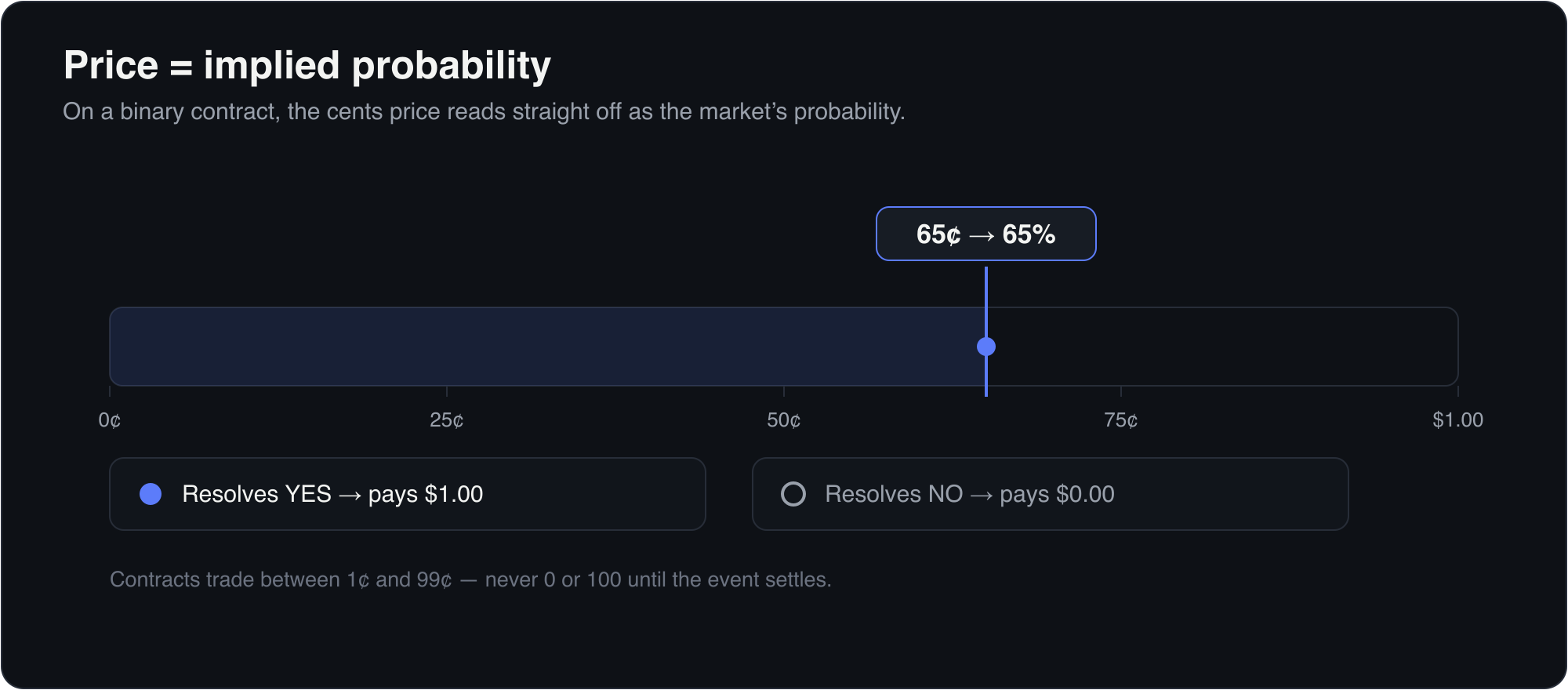
A prediction market is an exchange where people trade event contracts — financial instruments that pay out a fixed amount if a specific real-world outcome occurs and nothing if it does not. The defining feature is that the contract’s live trading price maps directly onto the crowd’s estimate of probability. On a CFTC-regulated venue like Kalshi, a typical contract pays $1 if the answer is “Yes” and $0 if “No,” and trades somewhere between 1 cent and 99 cents. A contract priced at 62 cents is the market saying, in dollars, that the event is roughly 62% likely. Buy “Yes” and you risk 62 cents to make 38; buy “No” and you risk 38 to make 62.
That single mechanic — price equals probability — is what separates prediction markets from ordinary betting and makes them interesting to quants. As economists Justin Wolfers and Eric Zitzewitz argued in their foundational 2004 paper, “Prediction Markets” (Journal of Economic Perspectives), the price of a “winner-take-all” contract is, under reasonable assumptions, the market’s estimate of the probability of the event.
Risk note: Event contracts carry a genuine risk of loss, prices can be volatile or thinly traded, and nothing in this guide is investment advice. Treat implied probabilities as a noisy signal, not a guarantee.
From a question to a price
Every market starts with a precisely defined, verifiable question and a resolution date — for example, “Will the Fed cut rates at its June meeting?” Traders take the side they think is mispriced. Buying pressure on “Yes” pushes the price up; buying pressure on “No” pushes it down. At resolution, the contract settles at $1 or $0 depending on the documented outcome, and the people who were right collect from the people who were wrong.
Liquidity is provided either by a traditional order book (matching resting buy and sell orders, as on Kalshi) or by an automated market maker (AMM) that quotes prices algorithmically. Manifold, for instance, runs an AMM it calls Maniswap, adapted from Uniswap’s formula. Either way, the output is the same: a continuously updating, machine-readable probability.
The Three Contract Types Every Trader Should Know
Wolfers and Zitzewitz formalized a clean taxonomy that still maps onto every modern venue. Each structure surfaces a different statistic about the market’s beliefs.
| Contract type | Question it answers | What the price reveals | Example |
|---|---|---|---|
| Binary (winner-take-all) | Will X happen, yes or no? | The probability of the event | ”Will it rain in NYC tomorrow?” trading at $0.30 → ~30% |
| Categorical (multi-outcome) | Which of several outcomes wins? | A probability distribution across mutually exclusive results | ”Who wins the election?” — each candidate has a price summing to ~$1 |
| Scalar / index | What will the number be? | The market’s expected value (mean) or median | ”How many seats will Party A win?” or a price-range contract |
- Binary contracts are the workhorse and the easiest to reason about — payoff is 0 or 1, price is the probability.
- Categorical markets list several mutually exclusive answers (e.g., presidential nominees). Because the outcomes are exhaustive, the prices should sum to roughly $1; gaps are arbitrage opportunities. Wikipedia’s prediction market overview notes these can become computationally unwieldy when many outcomes combine.
- Scalar/index contracts pay out in proportion to a number — vote share, seat count, GDP — so the price tracks the crowd’s mean estimate. A related “spread” contract, in Wolfers and Zitzewitz’s framing, reveals the median.
Understanding which type you’re trading matters: a binary “Yes” near 95 cents has almost no upside and large downside, whereas a scalar contract’s risk depends on the whole distribution of possible numbers.
Who Runs These Markets in 2026
The US landscape sorts into three buckets: CFTC-regulated real-money exchanges, play-money platforms, and broker front-ends that route customer orders to the regulated exchanges. Here is the current map.
| Venue | Type | Currency | Regulatory status (2026) |
|---|---|---|---|
| Kalshi | Designated Contract Market (exchange) | USD (real money) | CFTC-regulated DCM since Nov 2020 |
| Polymarket | On-chain exchange + new US entity | USDC on Polygon | US relaunch via CFTC-licensed QCEX |
| Manifold | Social/play-money | ”Mana” (non-cashable) | Not a regulated exchange |
| PrizePicks Predictions | Broker (FCM) front-end | USD | Routes to Kalshi & Polymarket |
| DraftKings Predictions | Broker front-end | USD | CFTC-registered |
Kalshi — the regulated pioneer
Kalshi was founded in 2018 by Tarek Mansour and Luana Lopes Lara and launched publicly in July 2021, after becoming a CFTC-designated contract market in November 2020, per Britannica and Wikipedia. Its contracts are the canonical Yes/No structure priced 1–99 cents and settling at $1. Kalshi’s most consequential contribution was legal: after the CFTC tried to block its congressional-control (election) contracts, the US District Court for D.C. ruled for Kalshi on September 6, 2024, and the D.C. Circuit denied the CFTC’s emergency stay on October 2, 2024, reasoning that elections are not “gaming.” The CFTC ultimately dropped its appeal in May 2025, leaving the pro-Kalshi decision intact and opening the door to political and sports event contracts nationwide.
Polymarket — on-chain scale and a US comeback
Polymarket, founded in 2020 by Shayne Coplan, is a blockchain-based exchange settling in USDC on the Polygon network, per Wikipedia. It paid a $1.4 million CFTC penalty in January 2022 for operating an unregistered facility and agreed to bar US customers. During the 2024 cycle it drew over $3.3 billion of volume on the Trump–Harris race (as of Nov 5, 2024). After the DOJ and CFTC closed their investigations in mid-2025, Polymarket acquired QCEX, a CFTC-licensed derivatives exchange, for $112 million to relaunch legally in the US, and later attracted a large strategic investment from Intercontinental Exchange (ICE). Polymarket’s CEO has also publicly called the platform “the most accurate thing we have” for gauging real-world odds.
Manifold — play money, full creativity
Manifold is a play-money social prediction platform. Users get a free starting balance in “Mana,” a currency that cannot be converted to cash. Anyone can create a market on virtually any topic, and the creator resolves it. Because there’s no real money at stake, Manifold is a low-risk sandbox for learning mechanics and testing forecasting skill — though that same lack of financial stake can weaken incentive-driven accuracy.
PrizePicks and DraftKings — sportsbooks become brokers
Two fantasy/sports-betting giants entered via the broker route. PrizePicks voluntarily ended its real-money “Pick’Em” contests in August 2025, then registered a subsidiary as a Futures Commission Merchant and announced partnerships with Kalshi and Polymarket in November 2025, surfacing exchange-listed “Team Picks” and “Culture Picks” inside its app across 38 states and D.C. DraftKings launched DraftKings Predictions on December 19, 2025, as a CFTC-registered broker connecting to exchanges such as CME Group. The key distinction for traders: these apps are conduits, not exchanges — your contract is a regulated event contract listed on the underlying venue.
Why Prices Carry Information: The Wisdom of Crowds
The intellectual case for prediction markets rests on information aggregation. Friedrich Hayek argued in 1945 that prices in a market efficiently synthesize knowledge dispersed across many individuals that no single planner possesses. James Surowiecki’s The Wisdom of Crowds (2004) specified the preconditions for a crowd to outperform experts: diversity of opinion, independence, decentralization, and a mechanism to aggregate — conditions a market is purpose-built to satisfy.
Crucially, markets add something a poll cannot: skin in the game. The marginal trader hypothesis holds that even if most participants are biased or noisy, profit-seeking traders will bet against obvious mispricings and drag the price toward the truth. That self-correcting pressure is why a contract price is often a sharper forecast than a survey — and why a thin market with few informed traders is less trustworthy.
How Accurate Are They, Really?
The strongest long-run evidence comes from the Iowa Electronic Markets (IEM), a small, real-money research exchange run by the University of Iowa Tippie College of Business since 1988, where traders may risk only $5 to $500 under CFTC no-action relief. In the influential Berg, Nelson, and Rietz study, the IEM’s election-eve prices were closer to the actual result than the polls 74% of the time, compared against 964 polls across five US presidential elections from 1988 to 2004. More recent peer-reviewed work, including a 2024 PS: Political Science & Politics analysis, continues to document low average vote-share errors.
But accuracy is not a law of nature. In 2016, prediction markets leaned heavily toward “Remain” in the Brexit referendum and toward Clinton over Trump — and got both wrong. Markets can become echo chambers when traders anchor on the current price instead of updating on new information. The honest summary: prediction markets are usually well-calibrated and frequently beat polls, but they are aggregators of human judgment and inherit human blind spots.
A note on where MispriceHQ fits
MispriceHQ exists to study exactly this question — where market-implied probabilities are likely mispriced relative to the true odds. Our own machine-learning approach to detecting those gaps is currently in development; we are building it in the open and make no claim to a live track record. This guide is part of the research foundation that work will rest on.
Key Risks Before You Trade
- Risk of loss. Event contracts can expire worthless. A “Yes” at 90 cents that resolves “No” is a total loss of that stake.
- Liquidity and thin markets. Niche contracts may have wide spreads, so the displayed probability can be unreliable and exits costly.
- Resolution risk. Ambiguous wording or disputed sources can cause a market to resolve against your reasonable reading. Always read the rules.
- Manipulation and concentration. A single large trader can move a thin market’s price away from the true probability, at least temporarily.
- Regulatory and jurisdictional limits. Availability differs by state and platform; rules are evolving quickly after the 2024–2025 court decisions.
- Not financial advice. None of this constitutes a recommendation; size positions to what you can afford to lose.
The Bottom Line
Prediction markets turn questions about the future into tradable prices, and those prices are a genuinely useful — if imperfect — probability forecast. The mechanics are simple (binary, categorical, scalar contracts that settle at a fixed value), the venues now span regulated exchanges and play-money sandboxes, and the empirical record is good enough to take seriously and humble enough to respect. For a trader, the edge isn’t in believing the crowd is always right; it’s in spotting the moments when the price and the true probability have come apart.
Frequently asked questions
What is a prediction market in simple terms?
It is an exchange where you trade contracts tied to whether a real-world event will happen. A contract typically pays $1 if the outcome occurs and $0 if it doesn't, so its price (say, 62 cents) reads as the crowd's estimated probability of that outcome (about 62%). You profit by buying contracts you think are underpriced and selling ones you think are overpriced.
How does a prediction market price equal a probability?
Because a binary 'winner-take-all' contract pays a fixed $1 if the event happens, a rational trader will pay up to their estimated probability times $1 for it. Competition among traders pushes the price toward the consensus probability. Economists Wolfers and Zitzewitz formalized this in 2004: the price of such a contract is the market's estimate of the event's probability.
Are prediction markets legal in the United States?
Real-money event contracts are legal when traded on a CFTC-regulated exchange. After courts ruled for Kalshi and the CFTC dropped its appeal in May 2025, political and sports event contracts became broadly available. Polymarket relaunched US operations by acquiring the CFTC-licensed QCEX exchange. Availability still varies by state and platform, so check local rules.
What are the main prediction market platforms in 2026?
The major real-money, CFTC-regulated exchange is Kalshi, alongside Polymarket's relaunched US entity. Manifold is a popular play-money platform using non-cashable 'Mana.' PrizePicks and DraftKings Predictions act as broker front-ends, routing customer orders to regulated exchanges like Kalshi and Polymarket rather than operating their own exchange.
Are prediction markets actually accurate?
Often, but not always. The Iowa Electronic Markets beat election-eve polls about 74% of the time across five US presidential elections from 1988 to 2004, and modern peer-reviewed studies show low vote-share errors. However, markets favored 'Remain' in Brexit and Clinton in 2016 and were wrong. Treat implied probabilities as a strong but fallible signal.
What are the risks of trading event contracts?
You can lose your entire stake if a contract resolves against you. Thin markets have wide spreads and unreliable prices, resolution can hinge on ambiguous rules, and large traders can move illiquid markets. Regulations vary by state and are evolving. Event contracts carry real risk of loss and are not financial advice; only risk what you can afford to lose.
- Prediction Markets — Journal of Economic Perspectives (Justin Wolfers & Eric Zitzewitz / AEA) (2004)
- Prediction market — Wikipedia
- Kalshi | Prediction Market Exchange, History, & Regulation — Britannica Money
- Kalshi — Wikipedia
- KalshiEX LLC v. CFTC, No. 24-5205 (D.C. Cir. 2024) — Justia / U.S. Court of Appeals, D.C. Circuit (2024-10-02)
- CFTC drops Kalshi election bet case appeal — CNBC (2025-05-05)
- Polymarket — Wikipedia
- Polymarket CEO says his prediction market is 'the most accurate thing we have' — CBS News / 60 Minutes
- Manifold (prediction market) — Wikipedia
- Iowa Electronic Markets — Wikipedia / University of Iowa
- Iowa Electronic Markets: Forecasting the 2024 US Presidential Election — PS: Political Science & Politics (Cambridge Core) (2024)
- DraftKings enters prediction markets with CFTC-approved app — CoinDesk (2025-12-19)