- In the US, event contracts are regulated as derivatives under the Commodity Exchange Act. They must be listed on a CFTC Designated Contract Market (DCM) and are typically introduced via self-certification under CEA section 5c(c)(1) and Regulation 40.2, not pre-approval.
- The CFTC can prohibit certain event contracts under the 'special rule' (CEA section 5c(c)(5)(C)) and Regulation 40.11 if they involve activity unlawful under federal or state law, terrorism, assassination, war, gaming, or are otherwise contrary to the public interest.
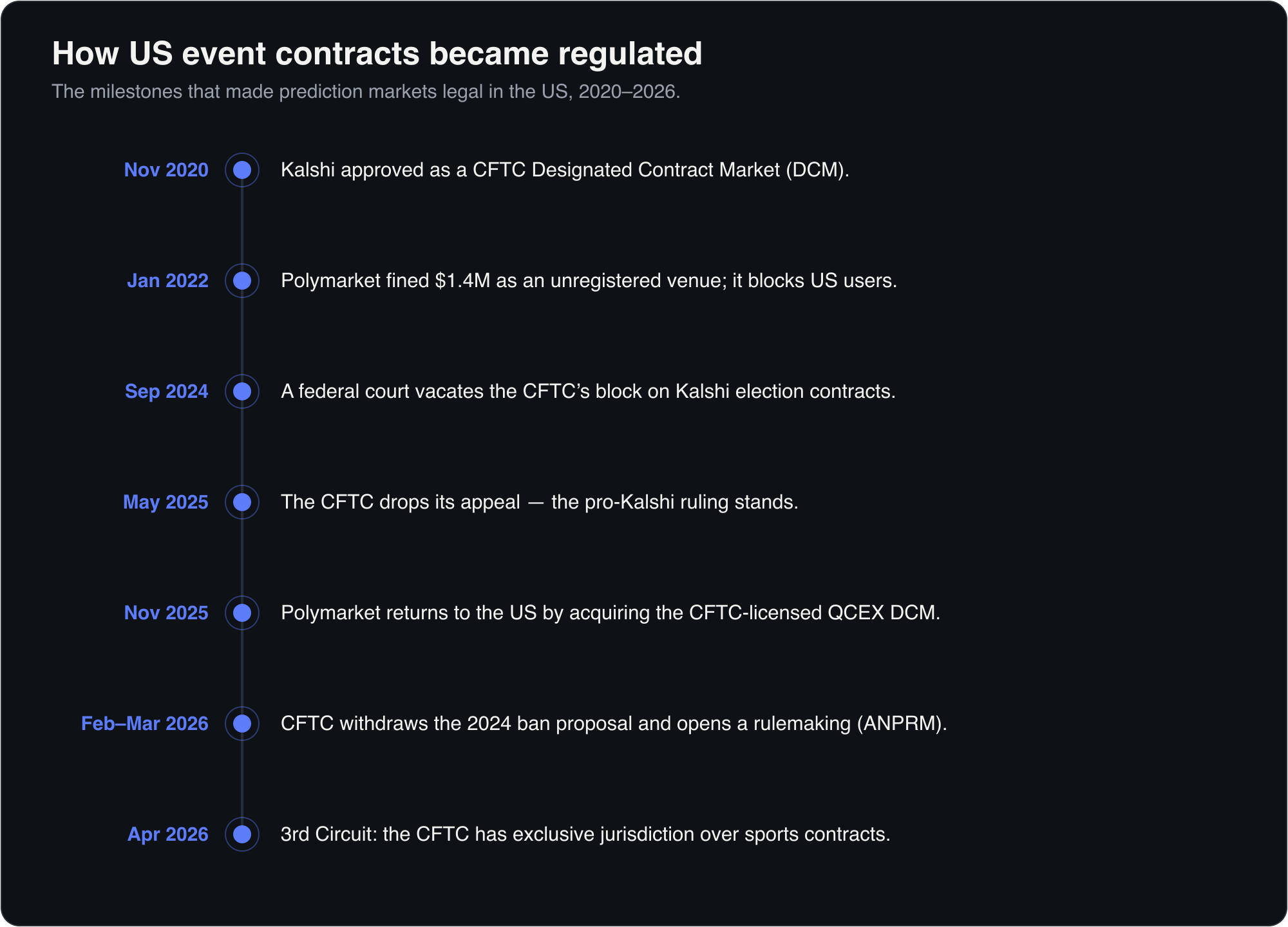
- The 2024 election-contracts fight ended in Kalshi's favor: a September 2024 district court ruling vacated the CFTC's block, and on May 7, 2025 the CFTC voluntarily dismissed its DC Circuit appeal, leaving that ruling intact.
- By 2026 the CFTC under Chairman Michael Selig had pivoted to an accommodative posture: it withdrew the 2024 proposed event-contract rule (February 2026) and issued an Advance Notice of Proposed Rulemaking (91 Fed. Reg. 12516) seeking comment, due April 30, 2026.
- Trading on a CFTC-regulated DCM means customer funds are segregated under CEA section 4d and 17 CFR 1.20, the venue is examined, and market-integrity Core Principles apply — protections largely absent on offshore or unregistered crypto venues.
- Event contracts carry real risk of loss and are not investment advice; regulated status reduces certain counterparty and custody risks but does not eliminate market or legal risk.
The short answer
In the United States, event contracts are regulated as derivatives under the Commodity Exchange Act (CEA), with the Commodity Futures Trading Commission (CFTC) as the federal overseer. To be offered legally to US persons, an event contract must be listed on a Designated Contract Market (DCM) — a CFTC-licensed exchange — and most contracts reach the market through self-certification under CEA section 5c(c)(1) and CFTC Regulation 40.2, where the exchange itself certifies compliance. The CFTC retains a backstop “special rule” to prohibit contracts it deems contrary to the public interest. After the 2024 election-contracts litigation resolved in the exchanges’ favor, and following a 2026 policy pivot, prediction markets now operate inside a federally regulated derivatives framework — not as state-licensed gambling.
Risk note: event contracts carry a real risk of loss and are not investment advice. Regulated status reduces certain custody and counterparty risks but does not remove market, legal, or liquidity risk.
What “event contract” means under the CEA
An event contract is a derivative — usually a binary option or swap with a yes/no payoff — whose settlement depends on whether a specified event occurs. The CFTC describes them as a type of derivative contract, “often a swap with a binary payoff structure,” settling on the outcome of an underlying occurrence. Because they are derivatives, they fall within the CFTC’s jurisdiction under the CEA rather than under state gaming regulators or the SEC.
This classification is the entire ballgame. If a yes/no contract on, say, an interest-rate decision or an election outcome is a CFTC-regulated swap, it lives in the federal derivatives world: exchange licensing, customer-fund segregation, and federal market-integrity rules apply. If it is instead deemed “gaming,” it would be a state matter subject to a patchwork of gambling laws. The 2024–2025 litigation, discussed below, turned squarely on which of those two boxes election contracts belong in.
The licensing backbone: Designated Contract Markets
The core requirement is venue. Event contracts offered to the US public must trade on a Designated Contract Market, the CFTC’s term for a fully licensed exchange (the same category as CME or ICE Futures U.S.). Per the CFTC’s DCM page, DCMs operate as front-line, self-regulatory organizations and must comply with 23 statutory Core Principles. Three are central to event contracts:
- Core Principle 3 — list only contracts not readily susceptible to manipulation;
- Core Principle 4 — actively prevent manipulation, price distortion, and settlement disruption through surveillance;
- Core Principle 12 — protect markets and participants from abusive practices and promote fair, equitable trading.
A DCM that lists event contracts therefore takes on continuing obligations — real-time monitoring, reliable settlement sources, and enforcement against abuse. The CFTC reinforced exactly these duties in its Division of Market Oversight advisory (CFTC Letter No. 26-08, March 12, 2026), which pressed DCMs listing sports event contracts to use official league-provided settlement data, maintain restricted-participant lists, and share information with integrity monitors.
How a contract gets listed: self-certification vs. approval
A DCM can bring a new event contract to market two ways, both spelled out on the CFTC’s listing-procedures page:
| Path | Authority | What it requires | Timing |
|---|---|---|---|
| Self-certification | CEA § 5c(c)(1); Reg. 40.2 | The DCM files a submission certifying the contract complies with the CEA and CFTC rules, with a complete explanation and analysis | No later than the close of business the day before initial listing |
| Prior CFTC approval | CEA §§ 5c(c)(4)–(5); Reg. 40.3 | The DCM requests Commission approval, with more detailed compliance analysis | Reviewed by the Commission before listing |
In practice the overwhelming majority of products — including event contracts — are launched via self-certification. The regulated entity assumes primary, ongoing responsibility for ensuring the contract continuously meets statutory and regulatory requirements; the CFTC supervises and can intervene rather than pre-clearing every product. This is the mechanism that let exchanges like KalshiEX keep listing contracts even while litigation was pending.
The CFTC’s backstop: the “special rule” and Regulation 40.11
Self-certification is not a free pass. The CEA gives the CFTC a targeted veto. Under the special rule at CEA section 5c(c)(5)(C), the Commission may determine that an event contract is contrary to the public interest — and therefore prohibited — if it involves any of an enumerated set of activities. CFTC Regulation 40.11 implements this, barring DCMs from listing contracts that reference:
- terrorism;
- assassination;
- war;
- gaming; or
- activity that is unlawful under any federal or state law.
The reach of that “gaming” category is precisely what blew up in 2024. The CFTC had also proposed, in June 2024, to expand Regulation 40.11 to sweep in political and sports contracts more explicitly — a rulemaking that became central to the fight and was ultimately abandoned (see the 2026 section below).
The 2024–2025 election-contracts litigation: Kalshi v. CFTC
The defining legal episode is KalshiEX LLC v. CFTC. Kalshi, a CFTC-regulated DCM, sought to list “Congressional Control Contracts” — yes/no contracts on which party would control each chamber of Congress after the November 2024 elections. The CFTC, in Press Release 8780-23, disapproved them, deeming them gaming and contracts involving activity unlawful under state law, and thus contrary to the public interest under Regulation 40.11.
Kalshi sued. The procedural arc:
- September 2024 — District court win. Judge Jia Cobb of the U.S. District Court for the District of Columbia vacated the CFTC’s order, holding the contracts did not involve unlawful activity or “gaming” within the meaning of the statute and that the CFTC had exceeded its statutory authority in conducting the public-interest review it used to block them.
- October 2024 — Stay then trading. The CFTC obtained a brief administrative stay while it sought an injunction pending appeal, but the DC Circuit declined to halt trading (No. 24-5205), and Kalshi’s election markets went live for the 2024 cycle.
- January 17, 2025 — Oral argument. A DC Circuit panel heard argument and, per contemporaneous coverage, signaled discomfort with the CFTC’s expansive reading of its own authority.
- May 7, 2025 — Appeal dismissed. The CFTC, following a 3–0 Commission vote (one abstention), voluntarily dismissed its appeal, as CNBC reported. The dismissal left Judge Cobb’s pro-Kalshi ruling intact and unchallenged.
The bottom line: as a matter of federal law, election event contracts on a regulated DCM are lawful under the CEA unless and until a higher court or new rulemaking changes that. The CFTC chose not to press the question further.
The parallel front: states vs. federal preemption
A separate battle pitted Kalshi against state gaming regulators over sports contracts. Kalshi argued that federal law preempts state enforcement because it operates as a CFTC-licensed DCM. Federal courts granted preliminary injunctions blocking state action: against the Nevada Gaming Control Board on April 9, 2025, and against New Jersey’s Division of Gaming Enforcement on April 28, 2025, with the New Jersey court finding “serious constitutional questions” and a likelihood of success on the merits. These were preliminary, not final — the deeper question of whether CFTC jurisdiction is fully exclusive remains unsettled — but the early momentum favored the federal-derivative theory.
The 2026 posture: from prohibition to rulemaking
By 2026 the CFTC’s stance had shifted markedly under new leadership. Chairman Michael Selig announced at a late-January 2026 joint SEC–CFTC summit a plan to support “the responsible development of event contract markets.” The concrete steps, per Sidley and Greenberg Traurig:
- February 2026 — Withdrawal of the 2024 proposed rule. The CFTC formally withdrew its June 2024 proposed amendments to Regulation 40.11 (which would have broadly prohibited political and sports event contracts), and withdrew a prior staff advisory that had warned of state enforcement risk.
- March 2026 — Advance Notice of Proposed Rulemaking. The CFTC issued an ANPRM (91 Fed. Reg. 12516) seeking public comment on the framework — Core Principles as applied to prediction markets, the prohibited-contract categories, inside-information and manipulation risks, margin, and blockchain-based markets — with comments due April 30, 2026.
- March 12, 2026 — Market-oversight advisory (Letter 26-08). Detailed supervisory expectations for DCMs listing sports contracts.
Translation: rather than banning categories of contracts, the 2026 CFTC is building a rulebook around them while keeping the existing DCM/self-certification machinery in place. The framework is being formalized, not dismantled — and, importantly, MispriceHQ’s own forecasting engine is still in development, so nothing here describes a live model or track record on our side; we are simply mapping the rules that govern the venues we research.
Why “regulated derivative” matters for traders
The practical difference between a CFTC-regulated DCM and an offshore or unregistered crypto venue is substantial:
| Feature | CFTC-regulated DCM (e.g., a licensed exchange) | Offshore / unregistered crypto venue |
|---|---|---|
| Legal status for US persons | Lawful derivatives venue under the CEA | Often unregistered; may be illegal to offer to US persons |
| Customer funds | Segregated under CEA § 4d and 17 CFR 1.20; cannot be commingled with the firm’s money | No federal segregation mandate; custody terms vary |
| Oversight | Examinations, Core Principle compliance, surveillance, enforcement | Limited or none |
| Manipulation rules | Core Principles 3, 4, 12 apply | Discretionary |
| Recourse on insolvency | Segregation designed to return customer funds | Uncertain |
Customer-fund segregation is the clearest protection. Under CEA section 4d, money a customer posts to margin or secure trades “shall be separately accounted for and shall not be commingled” with the intermediary’s funds — rules explicitly designed to protect customer money from misuse and to facilitate its return if the firm fails. Offshore venues offer no equivalent federal guarantee.
The contrast is concrete. Polymarket, a crypto-native venue, was fined $1.4 million by the CFTC on January 3, 2022 for operating an unregistered event-based binary-options facility without DCM designation or SEF registration, and was ordered to wind down non-compliant markets; it then blocked US users for years. Polymarket only returned to the US in December 2025 after acquiring QCEX, a CFTC-licensed derivatives exchange and clearinghouse, and obtaining an amended CFTC designation — i.e., by coming inside the regulated DCM perimeter. The regulatory path, not the offshore one, is what unlocked legal US access.
For traders, the takeaway is that the regulatory wrapper is a feature, not red tape: it dictates whether your funds are segregated, whether the venue is examined, and whether you have recourse. It does not, however, change the underlying risk that an event contract can settle worthless. For how we think about pricing those probabilities, see our methodology.
Bottom line
As of mid-2026, US event contracts are regulated derivatives: they trade on CFTC-licensed DCMs, reach the market chiefly via self-certification (CEA § 5c(c)(1), Reg. 40.2), and sit under a backstop prohibition power (the special rule and Reg. 40.11) that the agency has chosen to wield narrowly. The Kalshi litigation settled the headline question — election contracts on a DCM are lawful under the CEA — and the 2026 ANPRM signals a move toward a codified, accommodative rulebook rather than category bans. The enduring trader-facing point is structural: on a regulated venue, your funds are segregated and the market is supervised; offshore, they are not.
Frequently asked questions
Are event contracts legal in the United States in 2026?
Yes, when offered on a CFTC-licensed Designated Contract Market (DCM). They are regulated as derivatives under the Commodity Exchange Act. A September 2024 federal ruling and the CFTC's May 7, 2025 voluntary dismissal of its appeal established that election event contracts on a regulated exchange are lawful under the CEA. Contracts offered by unregistered offshore venues to US persons can still be illegal.
What is self-certification for event contracts?
Self-certification is the primary mechanism by which a DCM lists new contracts. Under CEA section 5c(c)(1) and CFTC Regulation 40.2, the exchange files a submission certifying that the contract complies with the CEA and CFTC rules, no later than the day before listing. The CFTC supervises and can intervene rather than pre-approving every product, though prior approval under Regulation 40.3 is an alternative.
Can the CFTC still ban certain event contracts?
Yes. The 'special rule' in CEA section 5c(c)(5)(C), implemented by Regulation 40.11, lets the CFTC prohibit contracts it deems contrary to the public interest if they involve terrorism, assassination, war, gaming, or activity unlawful under federal or state law. The scope of 'gaming' was the central dispute in the Kalshi case, and a 2024 proposal to broaden 40.11 was withdrawn in February 2026.
What happened in Kalshi v. CFTC?
Kalshi sought to list contracts on which party would control Congress; the CFTC blocked them as gaming. In September 2024, Judge Jia Cobb vacated that order, finding the CFTC exceeded its authority. The DC Circuit declined to halt trading, and on May 7, 2025 the CFTC voluntarily dismissed its appeal after a 3-0 vote, leaving the pro-Kalshi ruling intact.
How does a regulated DCM protect my funds compared with an offshore venue?
On a CFTC-regulated DCM, customer funds must be segregated under CEA section 4d and 17 CFR 1.20 — they cannot be commingled with the firm's money and are protected to facilitate return on insolvency. The venue is examined and subject to market-integrity Core Principles. Offshore or unregistered crypto venues have no equivalent federal segregation mandate. Polymarket only gained legal US access in December 2025 by acquiring a CFTC-licensed entity.
Does CFTC regulation make event contracts a safe investment?
No. Regulation reduces certain custody and counterparty risks — segregated funds, examined venues, surveillance — but it does not change the underlying risk that an event contract can settle worthless. Event contracts carry a real risk of loss, are speculative, and are not investment advice. State-law and jurisdictional questions, especially for sports contracts, also remained unsettled as of 2026.
- Contracts & Products (Event Contracts overview) — CFTC (2026)
- Designated Contract Markets (DCMs) — CFTC (2026)
- Listing Procedures (self-certification and approval) — CFTC (2026)
- CFTC Disapproves KalshiEX LLC's Congressional Control Contracts (Press Release 8780-23) — CFTC (2023-09-22)
- KalshiEX LLC v. CFTC, No. 24-5205 — DC Circuit order on stay — U.S. Court of Appeals for the D.C. Circuit (2024-10-02)
- CFTC drops Kalshi election bet case appeal — CNBC (2025-05-05)
- New Jersey Federal Court Sides with Kalshi Over Prediction Market Contracts — Holland & Knight (2025-05)
- U.S. CFTC Signals Imminent Rulemaking on Prediction Markets — Sidley Austin LLP (2026-02)
- CFTC Regulatory Developments on Prediction Markets and Event Contracts — Greenberg Traurig LLP (2026-03)
- CFTC Letter No. 26-08 (Division of Market Oversight advisory) — CFTC (2026-03-12)
- CFTC Orders Event-Based Binary Options Markets Operator (Polymarket) to Pay $1.4 Million Penalty (Press Release 8478-22) — CFTC (2022-01-03)
- 17 CFR § 1.20 — Futures customer funds to be segregated — Legal Information Institute, Cornell Law School (2025)