- Both are now CFTC-regulated Designated Contract Markets (DCMs): Kalshi since November 2020, and Polymarket via its $112M QCEX acquisition and a CFTC amended Order of Designation in November 2025.
- Kalshi runs fully on US dollars with bank/debit funding; Polymarket's global app settles in USDC on Polygon, while its new US app adds fiat and KYC.
- Fee models differ sharply: Kalshi uses a probability-weighted taker fee peaking at 1.75 cents per contract at even odds; Polymarket historically charged nothing and is now rolling out category-based taker fees with maker rebates.
- Settlement diverges: Kalshi resolves under CFTC exchange rules, while Polymarket's global markets resolve via the decentralized UMA optimistic oracle with a dispute window.
- Volume is enormous and sports-dominated on both, with Kalshi pulling ahead in monthly global volume through early 2026.
- Event contracts carry real risk of loss and are not financial advice; this is research, not a recommendation.
Kalshi vs Polymarket: the short answer
As of mid-2026, Kalshi and Polymarket are the two dominant prediction-market venues, and the gap between them has narrowed in one critical respect: regulation. Kalshi has operated as a CFTC-regulated Designated Contract Market (DCM) since November 2020. Polymarket — pushed out of the US by a 2022 CFTC settlement — has returned legally by acquiring a CFTC-licensed exchange (QCEX) and receiving a CFTC amended Order of Designation in November 2025. The practical differences now sit in funding (Kalshi is US-dollar-native; Polymarket’s global app runs on USDC), fees, settlement mechanics, and UX. Kalshi suits dollar-in, dollar-out US users; Polymarket appeals to crypto-native traders and those wanting its broad global market catalog.
Risk note: event contracts carry a real risk of loss, including total loss of capital. This article is research, not financial advice.
Regulation: two roads to the same DCM status
The regulatory story is the single biggest reason traders pick one platform over the other — and it has changed dramatically.
Kalshi was the first US company approved to run a DCM dedicated to event contracts. The CFTC issued KalshiEX LLC an Order of Designation on November 4, 2020, placing it under the same federal regime that governs futures exchanges. Kalshi describes itself as “regulated by the Commodity Futures Trading Commission (CFTC)” and operating as “a Designated Contract Market (DCM)” per its help center.
Polymarket’s path was rockier. On January 3, 2022, the CFTC entered an order against Blockratize, Inc. (d/b/a Polymarket) for operating an unregistered or non-designated facility for event-based binary options. Polymarket paid a $1.4 million civil penalty and was ordered to “facilitate the resolution (i.e. wind down) of all markets” that did not comply with the Commodity Exchange Act. That effectively ended legal US access for years.
The 2025 turnaround was structural, not cosmetic. Polymarket acquired QCEX — comprising QCX LLC (a CFTC-licensed contract market) and QC Clearing LLC (a clearinghouse) — for $112 million in July 2025. On November 25, 2025, the CFTC issued an amended Order of Designation enabling intermediated US access through futures commission merchants (FCMs), with the platform operating in the US as Polymarket US. In short: both platforms now offer a CFTC-regulated US venue. The legacy global Polymarket app remains a separate, offshore, crypto-settled product.
A notable adjacent signal: NYSE-parent Intercontinental Exchange (ICE) announced in October 2025 a strategic investment in Polymarket — reported at up to $2 billion per the company announcement — primarily to distribute Polymarket’s event-driven data. Kalshi, for its part, raised $1 billion at an $11 billion valuation in a round led by Paradigm, announced December 2, 2025. Both are now heavily capitalized.
Head-to-head comparison table
| Dimension | Kalshi | Polymarket |
|---|---|---|
| US regulatory status | CFTC-regulated DCM since Nov 2020 | Global app offshore/crypto; Polymarket US is a CFTC-regulated venue (QCX LLC) per amended order Nov 2025 |
| Currency | US dollars | USDC on Polygon (global); fiat added on US app |
| Funding | ACH, wire, debit card (and other methods on the US app) | USDC via wallet/on-ramp (global); bank transfer on US app |
| Taker fees | 0.07 × C × P × (1−P), max ~1.75¢/contract at 50¢ | Historically $0; category-based rollout in 2026 |
| Maker fees | 25% of taker (0.0175 × C × P × (1−P)) | $0 + rebates where fees apply |
| Settlement / resolution | CFTC exchange rules | UMA optimistic oracle (global) |
| 2025 annual volume | ~$23.8B (KuCoin) | ~$22B (KuCoin) |
| Market mix | ~80% sports (Pew) | More diversified; ~39% sports (Pew) |
| Mobile | Mature iOS/Android app | US iOS app launched May 2026 |
Fees: a formula vs. a moving target
Fee structures are where these platforms diverge most concretely, and where the comparison is easy to get wrong.
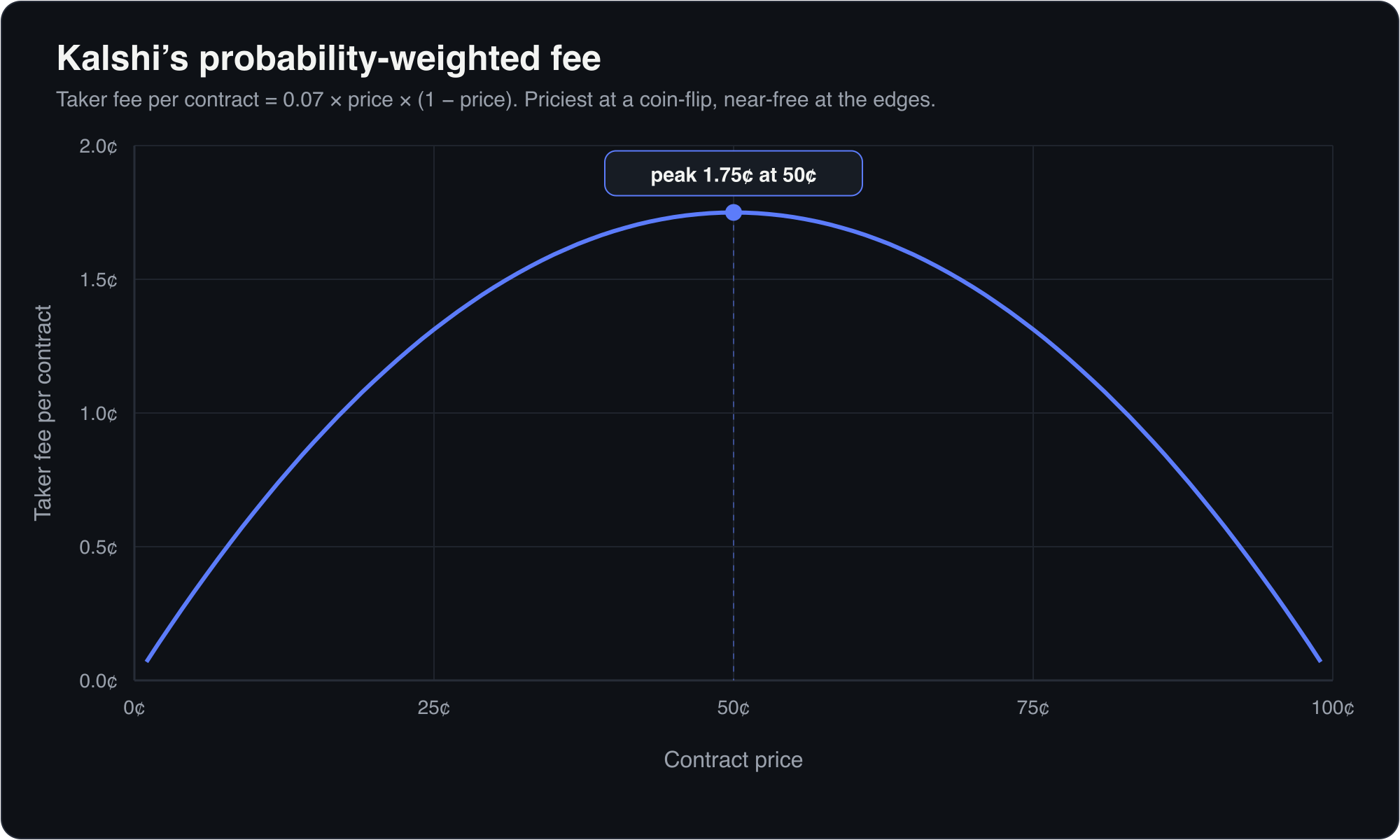
Kalshi charges a probability-weighted taker fee computed as round up(0.07 × C × P × (1 − P)), where C is contract count and P is price in dollars, per its fee schedule and reputable breakdowns. The fee peaks at 1.75¢ per contract at a 50¢ price and falls symmetrically toward the 1¢ and 99¢ extremes — so a longshot or near-certain contract costs far less to trade than a coin-flip. Maker fees run at 0.0175 × C × P × (1 − P), i.e. 25% of the taker fee. Kalshi began charging makers in 2025; before that, resting limit orders were free. Certain products, including its S&P 500 and Nasdaq-100 markets, use a halved multiplier (0.035 instead of 0.07), cutting costs in half on those contracts.
Polymarket historically charged no trading fees at all — a major draw. That is changing. Polymarket has been rolling out a dynamic, category-based taker fee through 2026. Per Polymarket’s own help center, Sports markets created on or after March 30, 2026 carry a taker fee that peaks at 0.75% at the 50/50 price point, while “Geopolitical & World Events” markets remain fee-free, with future expansion planned to Finance, Politics, Economics, Culture, Weather, and Tech. Makers generally pay nothing and can receive rebates funded by taker fees. Because Polymarket’s rollout is staged and category-specific, the only honest summary is: check the specific market — some are still free, some now carry a taker fee shaped like Kalshi’s curve.
A few important caveats so you don’t over-index on a single number:
- Polymarket’s two products differ. The global app and Polymarket US can have different fee schedules; figures above reflect the documented schedule on the global product. Treat US-app pricing as evolving.
- Network and on-ramp costs. Polymarket itself charges no deposit/withdrawal fee for USDC on Polygon, but third-party on-ramps (e.g. card providers) and gas add cost. On the Kalshi side, debit-card deposits can carry a third-party processing fee (commonly reported around 2%), while ACH is typically free — confirm current terms in-app.
Settlement and resolution: exchange rules vs. an oracle
How a market resolves is as important as how you enter it.
Kalshi settles under its CFTC-registered exchange rulebook. Outcomes are determined per pre-published contract terms and the exchange’s own resolution sources, with CFTC oversight, recordkeeping, and surveillance obligations attached. There is no on-chain dispute auction; resolution is an exchange function.
Polymarket’s global markets resolve through the UMA optimistic oracle, a decentralized, permissionless system. Anyone can propose an outcome by posting a USDC bond, after which there is a challenge window for disputes; if undisputed, the proposal finalizes and payouts begin. Disputes escalate to a UMA token-holder vote. This design is fast and transparent, but it has a different risk profile than exchange settlement: resolution quality depends on honest proposers and a functioning dispute process, and oracle manipulation is a known, studied concern in decentralized resolution. For US users, Polymarket US operates under DCM rules rather than relying solely on the oracle model — another reason to distinguish the two products.
Liquidity, volume, and contract breadth
Both venues are now genuinely large. Across 2025, combined activity was substantial: roughly $23.8 billion on Kalshi and $22 billion on Polymarket, per KuCoin’s market-share summary, with the two together accounting for about 97.5% of the sector. Monthly volume across these prediction markets rose from under $5 billion in September 2025 to about $24 billion by April 2026, according to Pew Research.
Two structural points matter for traders:
- Sports dominate, especially on Kalshi. Pew data indicate sports make up about 80% of Kalshi’s volume (since July 2024), versus a more diversified mix on Polymarket (~39% sports, ~32% politics). If you trade politics, macro, or culture, depth varies a lot by category — top sports books are deep enough to absorb sizable orders, while thinner categories carry meaningfully less liquidity on both platforms.
- Polymarket’s US vs. global split is real. In April 2026, Polymarket US saw about $1.3 billion in volume versus roughly $9 billion on the international app, per Pew. These measure structurally different things, so direct cross-platform comparisons require caution.
On contract breadth, both venues advertise large, fast-moving catalogs spanning politics, sports, economics, climate, financials, tech, and culture (Polymarket historically heavy on politics and crypto). In practice, breadth is comparable at the top of the funnel; liquidity concentration is the real constraint on both.
Fiat vs. crypto, UX, and mobile
This is the most tangible day-to-day difference.
- Kalshi is dollar-native. You fund with ACH, wire, or debit card, trade in USD, and withdraw to a bank — no wallet required. For most US users this is the lowest-friction path.
- Polymarket’s global app is crypto-native. Trading is denominated in USDC on Polygon; depositing USDC carries no Polymarket fee, but you must first acquire USDC via an exchange or on-ramp, and cashing out to a bank requires an off-ramp. The new Polymarket US app adds fiat funding and mandatory KYC, and launched on iOS for US users in May 2026 after a multi-month waitlist, opening initially with sports as the cleanest regulatory entry point.
On UX and mobile, Kalshi’s app is mature and bank-integrated. Polymarket’s interface is well-regarded for its clean market pages and real-time pricing; its US app is newer and rolling out features in stages. Quant-curious traders should note both offer APIs; Polymarket’s on-chain order book and UMA resolution are programmatically transparent, while Kalshi’s exchange API fits a more traditional market-data and order-routing workflow.
Which should you use?
- Choose Kalshi if you want a fully US-regulated, dollar-in/dollar-out experience with no crypto, predictable formula-based fees, and deep sports liquidity.
- Choose Polymarket if you value its broad global catalog, crypto-native settlement, and historically low (often zero) fees — and you’re comfortable with USDC and oracle-based resolution. US users should use Polymarket US for compliant access.
A closing note on method: at MispriceHQ, our own machine-learning fair-value engine is in development — we are building toward systematically flagging where market prices may diverge from modeled probabilities, but it is not yet live and has no track record. Until then, treat every quoted edge, including ours, as a hypothesis to test, not a signal to trade. Event contracts carry risk of loss; nothing here is financial advice.
Frequently asked questions
Is Polymarket legal in the US in 2026?
Yes, through Polymarket US. After a 2022 CFTC settlement forced it offshore, Polymarket acquired the CFTC-licensed exchange QCEX for $112 million and received a CFTC amended Order of Designation in November 2025, making QCX LLC (d/b/a Polymarket US) a regulated Designated Contract Market with intermediated access. Its US iOS app launched on May 12, 2026. The legacy global app remains a separate, offshore, crypto-settled product.
Is Kalshi regulated by the CFTC?
Yes. Kalshi has been a CFTC-regulated Designated Contract Market (DCM) since the CFTC issued KalshiEX LLC an Order of Designation on November 4, 2020. That places it under the same federal regime that oversees US futures exchanges, with associated recordkeeping, surveillance, and market-integrity obligations. Kalshi was the first US company approved to operate a DCM dedicated to event contracts.
Which is cheaper, Kalshi or Polymarket?
It depends on the market. Kalshi uses a probability-weighted taker fee that peaks at about 1.75 cents per contract at even (50-cent) odds and falls toward the extremes; makers pay 25% of that. Polymarket historically charged nothing and is now rolling out category-based taker fees in 2026 (for example, sports peaking around 0.75% at 50/50), with some categories still fee-free and maker rebates available. Always check the specific market.
What is the difference in how Kalshi and Polymarket settle markets?
Kalshi resolves markets under its CFTC-registered exchange rulebook, with the exchange determining outcomes per published contract terms under federal oversight. Polymarket's global markets resolve via the decentralized UMA optimistic oracle: a proposer posts a USDC bond, a challenge window allows disputes, and unchallenged proposals finalize. Disputes escalate to a UMA token-holder vote. Polymarket US operates under DCM rules rather than relying solely on the oracle.
Do I need cryptocurrency to use Kalshi or Polymarket?
Not for Kalshi, which is US-dollar-native and accepts ACH, wire, debit cards, Apple/Google Pay, PayPal, and Cash App (plus optional crypto). Polymarket's global app is crypto-native, denominated in USDC on the Polygon network, so you must acquire USDC via an exchange or on-ramp. The newer Polymarket US app adds fiat funding and mandatory KYC, reducing that friction for US users.
How big are Kalshi and Polymarket by trading volume?
Both are very large. Across 2025, reported annual volume was roughly $238 billion on Kalshi and about $220 billion on Polymarket, together comprising the vast majority of the sector. Monthly prediction-market volume rose from under $5 billion in mid-2025 to nearly $24 billion by April 2026, per Pew Research. Sports dominate activity on both, especially on Kalshi.
- CFTC Designates KalshiEX LLC as a Contract Market — CFTC (2020-11-04)
- CFTC Orders Event-Based Binary Options Markets Operator to Pay $1.4 Million Penalty — CFTC (2022-01-03)
- Polymarket Acquires CFTC-Licensed Exchange and Clearinghouse QCEX for $112 Million — PR Newswire (2025-07-21)
- Polymarket Receives CFTC Approval of Amended Order of Designation, Enabling Intermediated U.S. Market Access — PR Newswire (2025-11-25)
- ICE Announces Strategic Investment in Polymarket — Business Wire / Intercontinental Exchange (2025-10-07)
- Kalshi raises $1B at $11B valuation, doubling value in under two months — TechCrunch (2025-12-02)
- Trading Fees — Polymarket Help Center
- Resolution (UMA Optimistic Oracle) — Polymarket Documentation
- How is Kalshi regulated? — Kalshi Help Center
- Prediction Market Fees: Kalshi, Polymarket, Robinhood & Coinbase — DeFi Rate
- Trading volume on prediction markets has soared in recent months — Pew Research Center (2026-05-27)
- Kalshi and Polymarket account for 97.5% of the prediction market share in 2025 — KuCoin