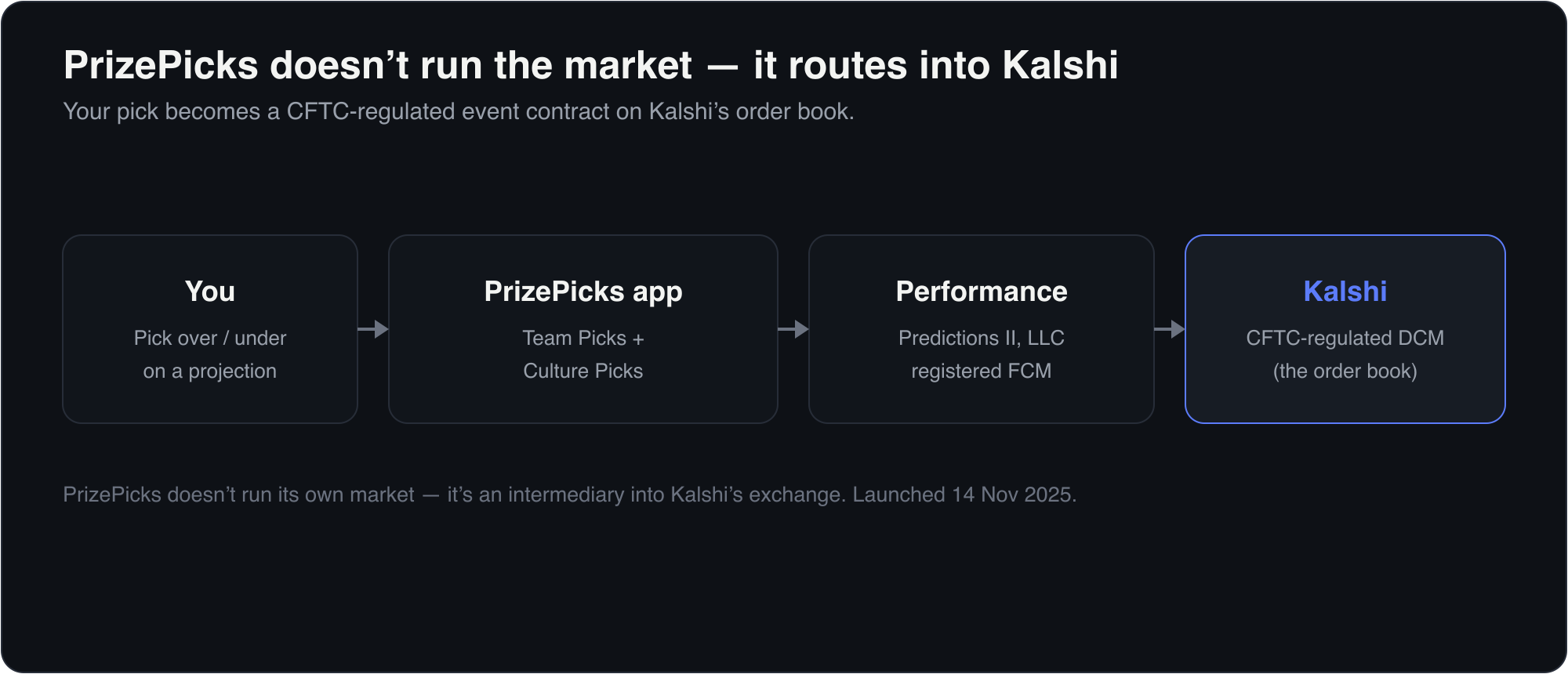
- PrizePicks launched prediction markets on November 14, 2025 through a multi-year partnership with Kalshi, the CFTC-regulated exchange — not its own order book.
- The product runs through subsidiary Performance Predictions II, LLC, which PrizePicks calls the first sports-entertainment operator registered as a Futures Commission Merchant (FCM) by the NFA.
- The pivot follows intense 2023-2024 state pressure on pick-em DFS: Florida cease-and-desist letters, a roughly $15M New York settlement, and lawsuits alleging pick-em was unlicensed sports betting.
- Prediction markets are CFTC-regulated event contracts, and a divided Third Circuit ruled in April 2026 that the CFTC has exclusive jurisdiction over Kalshi's sports contracts, preempting state gambling law.
- In January-February 2026 the CFTC, under Chairman Michael Selig, withdrew the 2024 proposed ban on political and sports event contracts and signaled new rulemaking is coming.
What PrizePicks Predictions Actually Are
PrizePicks predictions are CFTC-regulated event contracts that the daily-fantasy company began offering on November 14, 2025, through a multi-year partnership with the exchange Kalshi, according to PrizePicks’ own press release. PrizePicks does not run its own market; it acts as an intermediary into Kalshi’s order book through a subsidiary, Performance Predictions II, LLC, which the company describes as “the first sports entertainment operator to be registered as a Futures Commission Merchant (FCM) by the National Futures Association.” The product splits into Team Picks (sports outcomes) and Culture Picks (politics, awards, weather, crypto, entertainment). This is a genuine departure from PrizePicks’ core daily-fantasy “pick-em” product — and it arrived only after years of legal pressure on that original business.
Risk note: event contracts carry a real risk of loss. Nothing here is financial or legal advice.
From “PredictPicks” to DFS Behemoth
PrizePicks was conceived by Atlanta entrepreneur Adam Wexler in late 2014 and co-founded with Jay Deuskar under the name PredictPicks, per Wikipedia’s company profile. The name changed to PrizePicks in October 2018. The company grew into what it bills as the largest daily fantasy sports operator in North America, headquartered in Atlanta and, as of April 2024, in the Star Metals building in West Midtown.
The corporate picture shifted sharply in 2024-2026. Former Blizzard Entertainment president Mike Ybarra became CEO on August 5, 2024, with Wexler moving to executive chairman. Then, on January 16, 2026, European lottery operator Allwyn completed the purchase of a 62.3% stake in PrizePicks for roughly $1.5 billion. A deep-pocketed, regulation-savory parent reshapes the incentives behind a pivot into federally regulated markets.
PrizePicks’ flagship product was pick-em DFS: users selected two or more players and predicted whether each would go over or under a statistical projection, with a fixed payout for a correct slate. To critics — and to a growing list of state regulators — that looked a lot like a parlay of player props against the house rather than a contest among fantasy participants.
The 2023-2024 Legal Storm Over Pick-Em
The core legal theory against pick-em DFS is straightforward: when the operator sets the line and pays the winners, it is acting as the betting counterparty, not a neutral contest host. Regulators argued that made pick-em unlicensed sports betting, as the law firm Stinson LLP summarized.
The pressure was broad and fast-moving:
- Florida: The Florida Gaming Control Commission issued cease-and-desist letters to PrizePicks, Underdog Fantasy, and Betr, directing them to stop “offering or accepting illegal bets or wagers.” All three exited pick-em in the state by March 1, 2024, per World Casino Directory.
- New York: After the state moved against proposition-style fantasy contests, PrizePicks agreed to pay nearly $15 million for operating without a license and left the state (Stinson; Wikipedia).
- Massachusetts: A civil lawsuit named PrizePicks, Underdog, and Yahoo Fantasy Sports, as Stinson LLP notes, seeking damages tied to amounts wagered through pick-em contests.
- Other states: Arkansas, Kansas, Maryland, Maine, Michigan, Ohio, Wyoming, and Virginia all weighed in against pick-em-style contests, per multiple firm summaries.
PrizePicks responded by reworking its product into peer-to-peer formats (an “Arena”-style offering) in markets where pick-em was no longer viable. But the writing was on the wall: a state-by-state legal model was fragile for any product that resembled betting without a betting license. That fragility is exactly what made the federal prediction-markets framework so attractive.
Why Event Contracts Are a Different Legal Animal
A prediction market reframes an outcome as a financial event contract rather than a wager. The Commodity Futures Trading Commission (CFTC) — which says it has regulated prediction markets since 2004 — describes event contracts as derivatives structured as swaps, typically “yes-no scenarios” with a “fixed payout (usually $1) and an expiration,” on the CFTC’s own prediction-markets page. Contracts trade between roughly $0.01 and $0.99; a “Yes” price of $0.65 implies the market’s view of a 65% probability. Winning contracts settle at $1.00, losers at $0.00.
The crucial regulatory distinction:
| Dimension | Sportsbook (e.g., DraftKings book) | Prediction market (e.g., Kalshi) |
|---|---|---|
| Primary regulator | State gaming commissions | CFTC (federal) |
| Legal instrument | Wager at fixed odds | Event contract / swap |
| Who sets the price | The book (with a vig) | Traders; exchange “does not take a side” |
| Licensing model | State-by-state | Federal Designated Contract Market (DCM) |
| Counterparty | The house | Other traders via the exchange |
Because a Designated Contract Market clears a stringent CFTC application and exchanges “do not take a side of the trade” (CFTC), proponents argue event contracts sit squarely under federal commodities law — not state gambling law. That is the heart of the legal fight that defined 2025.
The 2025 “Gold Rush” and the Kalshi Precedent
Kalshi lit the fuse. On January 24, 2025, it began offering sports-based event contracts, as Stinson LLP recounts, and the CFTC did not block them. States including Nevada, New Jersey, and Maryland fired back with cease-and-desist letters arguing this was unlicensed sports wagering. The courts split: federal district courts in Nevada and New Jersey sided with Kalshi on preemption, while a Maryland court declined to enjoin the state regulator.
The most consequential ruling came on April 6, 2026, when a divided panel of the Third Circuit held in KalshiEX LLC v. Flaherty that the CFTC has exclusive jurisdiction over Kalshi’s sports-related event contracts and that the Commodity Exchange Act preempts New Jersey’s gambling laws, as Paul, Weiss analyzed. The firm described it as the first federal court of appeals to address prediction-market jurisdiction — a strong tailwind for any company routing trades through a DCM, though a circuit split and possible Supreme Court review remain.
The regulatory posture then turned decisively friendlier. On February 4, 2026, the CFTC under Chairman Michael S. Selig withdrew both the June 2024 proposed rule that would have restricted political and sports event contracts and a September 2025 staff advisory, per the CFTC’s official press release. Selig said the prior proposal “reflected the prior administration’s frolic into merit regulation,” that the advisory “inadvertently created confusion and uncertainty,” and that he looked forward to “an event contracts rulemaking.”
Against that backdrop, the broader industry piled in. DraftKings Predictions launched on December 19, 2025, and FanDuel Predicts debuted December 22, 2025 in partnership with CME Group, according to SportsHandle. The parallels to the DFS land-grab a decade earlier are hard to miss.
What PrizePicks Predict Offers Now
Here is what can be stated with confidence from primary and authoritative sources, and what remains uncertain.
Verified:
- Launch: November 14, 2025, multi-year deal with Kalshi (PrizePicks press release).
- Structure: All event contracts on PrizePicks are Kalshi markets; PrizePicks is the FCM intermediary via Performance Predictions II, LLC, per the launch coverage and a BettingUSA review.
- Two product lines: Team Picks (pick the winner of a game, fight, or match, plus season-long futures) and Culture Picks (music, movies, politics, awards, weather, crypto).
- Availability: Team Picks and/or Culture Picks were live in 38 states plus Washington, D.C. at launch, with Culture Picks far more widely available than the narrower sports-focused Team Picks.
- Mechanics: Yes/No contracts settling at $1.00 or $0.00; the app displays prices as payout multipliers and lets users sell positions before settlement (BettingUSA review).
Treat as uncertain or unconfirmed. Note that PrizePicks ran two near-simultaneous announcements: a Polymarket partnership dated November 11, 2025 to “facilitate the purchase of event contracts,” per a separate PrizePicks release, and the Kalshi launch on November 14. The live, CFTC-regulated product described in launch coverage runs on Kalshi; the precise current role of Polymarket, and any change to it, is not something we can verify here. Exact state counts for Team Picks specifically vary across sources (one review lists 33 states; the launch release frames sports as a subset of the 38-state footprint and notes some are states without legal sportsbooks). Fee figures cited by third-party reviews (roughly $0.005-$0.02 per contract) come from a review site, not a PrizePicks disclosure, so treat them as indicative rather than authoritative.
What It Means for Traders
For a prediction-market trader, the headline is liquidity and access, not novelty: PrizePicks Predict is a branded front end into Kalshi, so the underlying prices and depth are Kalshi’s. The strategic significance is regulatory. A company that was forced out of multiple states over pick-em has found a federally regulated lane to offer something economically similar — sometimes in states with no legal sportsbook at all. That arbitrage between state gaming law and federal commodities law is precisely what the courts and the CFTC are still adjudicating, and the legal picture remains genuinely unsettled.
At MispriceHQ, our own machine-learning model for identifying mispriced event contracts is still in development — we have no live track record and no resolved markets to report. When it ships, our intended approach is to compare implied probabilities like the ones on PrizePicks Predict against independent model forecasts. Until then, treat every quoted price as a market opinion, size positions only with risk capital, and remember that a friendly appellate ruling today can be revisited by the Supreme Court tomorrow.
Frequently asked questions
Does PrizePicks run its own prediction market?
No. PrizePicks Predict is a front end into Kalshi, the CFTC-regulated exchange. Under a multi-year partnership announced on November 14, 2025, all event contracts shown in the PrizePicks app are Kalshi markets. PrizePicks acts as the intermediary through its subsidiary Performance Predictions II, LLC, which it describes as the first sports-entertainment operator registered as a Futures Commission Merchant by the NFA.
Why did PrizePicks move from pick-em DFS to prediction markets?
Pick-em daily fantasy faced intense state legal pressure in 2023-2024. Regulators argued that picking players over or under projections against the house was unlicensed sports betting. Florida issued cease-and-desist letters, New York reached a roughly $15 million settlement, and lawsuits followed in states like Massachusetts. CFTC-regulated event contracts offer a federal framework that sidesteps state-by-state gaming licensing, which is why PrizePicks and rivals pivoted.
What is the difference between Team Picks and Culture Picks?
Team Picks are sports event contracts — predicting the winner of a game, fight, or match, plus season-long futures like win totals and championships. Culture Picks cover non-sports events: politics, award shows such as Best Picture or Album of the Year, weather, crypto, and entertainment storylines. Both are Kalshi event contracts that settle at $1.00 if correct and $0.00 if not. Culture Picks were available in more states than Team Picks at launch.
Are PrizePicks prediction markets legal everywhere?
The legal status is contested and evolving. Prediction markets are CFTC-regulated event contracts, and in April 2026 a divided Third Circuit held the CFTC has exclusive jurisdiction over Kalshi's sports contracts, preempting New Jersey gambling law. But courts have split, and Supreme Court review is possible. At launch, PrizePicks Predict was available in 38 states plus Washington, D.C., with sports Team Picks in a narrower subset. Availability can change with litigation.
How do event contracts differ from a sportsbook bet?
A sportsbook bet is placed at fixed odds against the house, which sets the line and keeps a margin (the vig). An event contract is a financial instrument traded on an exchange between participants; the exchange does not take a side. Contracts price between about $0.01 and $0.99, where the price implies a probability, and winners settle at $1.00. Sportsbooks are state-regulated; event contracts are CFTC-regulated.
Does MispriceHQ have a working model to value PrizePicks contracts?
No. MispriceHQ's machine-learning model for identifying mispriced event contracts is in development. It has no live track record and has not resolved any markets. Our intended future approach is to compare market-implied probabilities, like those on PrizePicks Predict and Kalshi, against independent forecasts. Until it ships, treat every quoted contract price as a market opinion, not a verified edge, and trade only with risk capital.
- PrizePicks Launches Prediction Markets Offering with Kalshi — PrizePicks
- PrizePicks Partners with Polymarket for Prediction Markets Expansion — PrizePicks
- Understanding Prediction Markets and Event Contracts — U.S. Commodity Futures Trading Commission
- CFTC Withdraws Event Contracts Rule Proposal and Staff Sports Event Contracts Advisory (Release 9179-26) — U.S. Commodity Futures Trading Commission (2026-02-04)
- A Divided Third Circuit Holds That the CFTC Has Exclusive Jurisdiction Over Sports-Related Event Contracts — Paul, Weiss (2026-04-06)
- Sportsbooks or Commodity Exchanges? The Rising Legal Tensions Between Sports Betting and Prediction Markets — Stinson LLP
- In Florida and Elsewhere, Officials Target Latest Fantasy Sports Games — Stinson LLP
- Daily Fantasy Sports Pick-em Operators to Leave Florida by March 1, 2024 — World Casino Directory
- PrizePicks — Wikipedia
- PrizePicks Launches Kalshi Event Contracts in 38 States — SBC Americas (2025-11-14)
- PrizePicks Prediction Markets Review 2026: Team Picks & Culture Picks — BettingUSA
- Beyond the Bookie: The Rise of U.S. Prediction Markets — SportsHandle