- Manifold is a pure play-money prediction market: its currency, mana, cannot be cashed out, which keeps it outside CFTC and gambling regimes and means no KYC for normal use.
- Anyone can create a market on anything, and creators usually resolve their own questions. This drives enormous breadth (100,000+ markets) but uneven quality and liquidity.
- Manifold launched a real-cash 'sweepcash' sweepstakes layer in September 2024, then shut it down on 28 March 2025, converting balances back to mana at 100:1 and refocusing on play-money.
- Forecasting accuracy is respectable but trails calibration-focused platforms: one analysis found Manifold's mean Brier score (0.107) behind Metaculus (0.084) on 64 shared questions.
- The free, open-source API (read markets, place bets, create markets, websockets) is among the most developer-friendly in the category, making Manifold a strong sandbox for bots and research.
The short answer
Manifold Markets is a play-money prediction market where the currency, called mana (M), has no cash value and cannot be withdrawn. You get M1,000 free on signup, bet on user-created questions about anything, and climb leaderboards on reputation rather than profit. Because mana is not redeemable, Manifold sits outside the CFTC event-contract regime and state gambling law, so there is no KYC for ordinary use and access is broad. The trade-off is the obvious one: skill does not convert to withdrawable money. Manifold briefly bolted on a real-cash “sweepcash” layer in late 2024 and announced its wind-down on 13 February 2025 (final cash-outs closing 28 March 2025), returning to pure play-money. For traders, the signal is real but noisier than cash markets; for builders and researchers, the open API is a genuine draw.
Risk note: This is a review, not financial advice. Real-money event contracts elsewhere carry a risk of total loss. Manifold itself is play-money, so the “risk” is mostly your time and attention.
What Manifold actually is
Manifold was founded in December 2021 by Austin Chen and brothers James and Stephen Grugett, per Wikipedia’s record of the project. It grew out of the rationalist/effective-altruism orbit: early backing included a grant from the Astral Codex Ten program, roughly $340,000 from the Survival and Flourishing Fund, and $1.5 million from the FTX Future Fund — the same Sam Bankman-Fried vehicle that later collapsed. Worth knowing as context, not as a knock on the current product.
The core loop is simple. Markets run on a constant-product automated market maker the team calls maniswap, a variant of the Uniswap design. Every account starts with M1,000 complimentary, and you top up mana through trading profits, daily and weekly quests, phone verification, referrals, or by buying it outright. According to the official FAQ, prediction streaks pay M5/day rising to M25, creating a market earns M100, and phone verification is a one-time M1,000.
Market formats are broad: Yes/No (binary), multiple choice, numeric, polls, and bounty questions. The defining design choice is permissionless creation — anyone can spin up a market on anything, from “Will GPT-6 ship in 2026?” to “Will my friend finish their thesis?” That openness is Manifold’s superpower and its main liability, for reasons we will get to.
The currency that can’t be cashed out
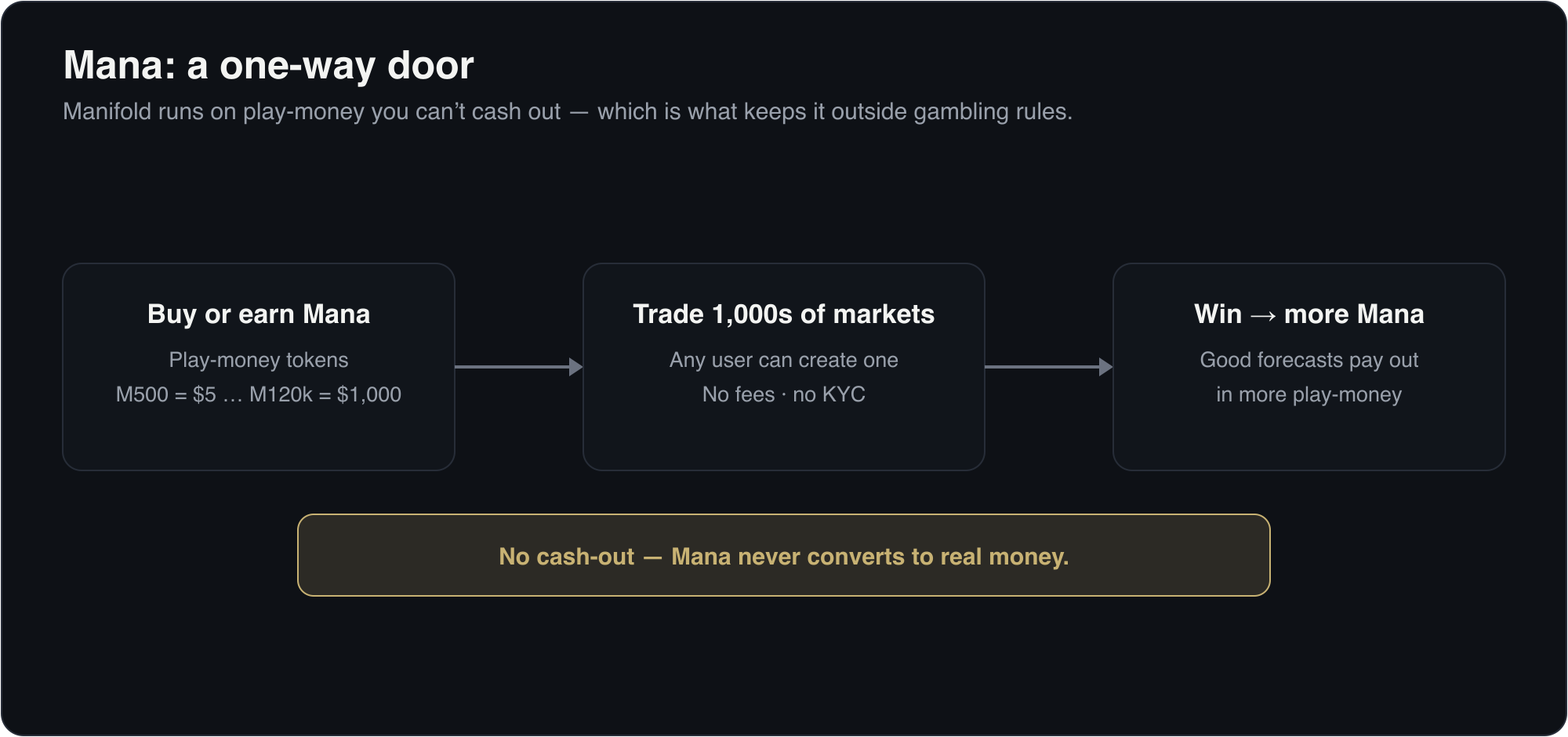
This is the single most important fact about Manifold, so it is worth stating plainly. Mana cannot be converted to cash. The FAQ says so directly: “It cannot be converted to cash.” There is no withdrawal button, no bank linkage, no crypto off-ramp for ordinary mana.
That constraint is a feature, not a bug, in regulatory terms. Manifold’s own materials have long argued that play money “has the important advantage of not being subject to CFTC regulation or gambling laws,” which is precisely why a small team can let users create tens of thousands of markets that a real-money exchange like Kalshi — which lists CFTC-regulated event contracts — could never touch. Independent reviewers confirm the practical upshot: a 2026 CryptoSlate review notes Manifold is “not a regulated prediction event exchange,” that live trading fees are currently zero, and that “no KYC is required for normal use,” though access “still depends on local law.”
Mana does cost real money if you choose to buy it — purchase tiers in the same review run from M500 for $5 up to M120,000 for $1,000 — but that is a one-way door. You are buying play tokens, not an investment.
The 2024 sweepstakes detour — and the 2025 reversal
For most of 2024, Manifold tried to thread the needle between play-money and real stakes. The path it chose was a sweepstakes model, the same legal structure used by social-casino operators.
The reasoning was laid out in a May 2024 post, “Cash prizes for good predictions”: “Online sweepstakes are legal in the United States, provided they adhere to both federal and state regulations,” and platforms “like Chumba and Fliff have been operating since 2017 and 2019 (respectively) and process billions of dollars.” The mechanism used a parallel currency — first “Prize Points,” later rebranded — that paid out on curated, unambiguous markets and could be redeemed for cash or donated to charity.
The real-cash version went live as sweepcash on 25 September 2024, per the official “Cash prizes are here!” announcement. The terms: selected questions ran a sweepcash market alongside the mana market; 1.00 sweepcash redeemed to 1.00 USD minus a 5% withdrawal fee; you could only withdraw sweepcash once it had won a resolved market; and charity cash-outs were fee-free. Mana stayed the default play currency throughout.
It did not last. On 13 February 2025, Manifold published “Focusing on Mana, Bringing Sweepstakes to an End”. The stated reasons were strategic rather than legal: sweepstakes “unfortunately haven’t met our usage goals” and “they’ve been drawing focus away from building out the core platform you know and love.” The wind-down terms:
| Event | Detail |
|---|---|
| Announcement date | 13 February 2025 |
| New sweepcash issuance | Halted immediately |
| Final cash-out / donation deadline | 28 March 2025 |
| Leftover sweepcash conversion | Auto-converted to mana at 100 mana : 1 sweepcash |
| Markets closing after 3 March 2025 | Resolved to current probability |
So as of this 2026 review, Manifold is once again a pure play-money platform. The sweepstakes documentation pages (/sweepstakes, /sweepstakes-rules) now return 404s, consistent with the program’s sunset. Anyone evaluating Manifold today should ignore older write-ups that still describe withdrawable cash — that era lasted roughly six months.
How good are the forecasts?
This is where intellectual honesty matters most, because “play money” invites a reasonable objection: without financial skin in the game, why trust the prices?
Manifold’s answer is that reputation and leaderboards supply the incentive, and the platform publishes its own live calibration chart. The methodology samples markets with 15 or more traders and uses trade-weighted calibration; the closer the dots sit to the diagonal, the better.
The harder comparison is against rigor-focused platforms. A study reproduced on Metaculus and discussed on the EA Forum compared 64 binary questions that existed on both platforms: Metaculus posted a mean Brier score of 0.084 versus Manifold’s 0.107, and Metaculus was more accurate on about 75% of the shared questions. (Lower Brier is better.) The study’s author cautions that the 64 questions were not randomly selected — they skewed toward effective-altruism and Ukraine topics — and that Metaculus typically had many more forecasters per question, both of which likely widened the gap.
The honest read: Manifold’s crowd is well-calibrated enough to be useful signal, especially on high-traffic political and cultural questions, but it is not the sharpest forecasting source available. For breadth and speed it is excellent; for the tightest calibration on technical or scientific questions, a dedicated forecasting platform like Metaculus, or a cash market with real liquidity, will usually beat it. Treat Manifold prices on thin, niche, self-resolved markets with appropriate skepticism.
The API: Manifold’s quiet strength
If you are quant-curious, this is the section that matters. Manifold runs a free, open-source API that is among the most developer-friendly in the category. Per the API docs and corroborated by CryptoSlate, you can:
- Read markets, users, bets, comments, and positions across the whole site
- Place bets and limit orders programmatically
- Create and resolve your own markets via code
- Subscribe to real-time websocket feeds for new bets, comments, and market updates
The rate limit is 500 requests per minute per IP, public read endpoints need no auth, and write actions use a per-account API key. Some actions cost mana (creating a binary market runs ~M50; API comments incur an M1 fee), which doubles as light spam protection. For researchers building datasets, bot authors testing strategies, or anyone prototyping a forecasting tool, this open data layer is a real reason to choose Manifold over more closed competitors.
Strengths and limitations
| Dimension | Strength | Limitation |
|---|---|---|
| Cost & access | Free, no KYC, zero trading fees, broad geographic access | No real-money upside; mana purchases are one-way |
| Breadth | Tens of thousands of user-created markets on virtually any topic | Long tail of low-quality, thinly traded questions |
| Resolution | Fast, community-driven | Creators resolve their own markets — bias and disputes happen |
| Accuracy | Well-calibrated on high-traffic markets; public calibration data | Trails Metaculus on shared questions (though on a non-random, small sample) |
| Developers | Open, documented, free API with websockets | Write actions cost mana; not a data SLA |
| Stability | Refocused on a sustainable play-money core | Has pivoted before (sweepstakes 2024-25); roadmap can shift |
One non-product caveat worth flagging for completeness: Manifold’s in-person Manifest conference drew critical coverage in 2024 over some invited speakers associated with “human biodiversity”/race-science circles — claims the organizers and several attendees contested. This concerns the events arm and surrounding community, not the trading product itself, but it is part of the platform’s public footprint and we would rather you hear it from us than be surprised by it.
Who it suits
- Newcomers to prediction markets who want to learn the mechanics without risking money — Manifold is arguably the best free sandbox available.
- Forecasters who value breadth and speed and care about reputation, streaks, and community over payouts.
- Developers, quants, and researchers who want an open API and a large, queryable corpus of markets and bets.
- Not for anyone seeking withdrawable returns — that door closed in March 2025. For real-money event contracts, look to regulated venues and read their terms carefully.
At MispriceHQ we study where crowd prices diverge from fair value, and our own machine-learning engine for spotting mispriced event contracts is still in development — no live track record yet. When we evaluate signal sources, Manifold earns a specific role: a fast, open, free read on what an engaged crowd thinks, best used alongside cash markets and dedicated forecasting platforms rather than as a standalone oracle. Used that way — play money, real signal — it is one of the most useful free tools in the space.
Frequently asked questions
Can you withdraw real money from Manifold Markets?
No. Manifold's currency, mana, cannot be converted to cash, as its own FAQ states plainly. From September 2024 to March 2025 a separate 'sweepcash' layer allowed real cash redemption at 1:1 minus a 5% fee, but Manifold ended that program on 28 March 2025 and converted remaining sweepcash to mana at 100:1. Today it is purely play-money, so forecasting skill does not turn into withdrawable profit.
Is Manifold Markets legal, and does it require KYC?
Because mana has no cash value, Manifold operates outside the CFTC event-contract regime and state gambling laws, and no KYC is required for normal use. Access is broad with no fixed country whitelist, though it still depends on local law. It is explicitly not a regulated prediction event exchange, unlike CFTC-registered venues such as Kalshi.
Why did Manifold shut down its sweepcash sweepstakes?
In its 13 February 2025 post 'Focusing on Mana, Bringing Sweepstakes to an End,' Manifold said the sweepstakes 'haven't met our usage goals' and were 'drawing focus away from building out the core platform.' The reasons given were strategic rather than legal. New sweepcash issuance stopped immediately, with a 28 March 2025 cash-out deadline and automatic conversion of leftover balances to mana at 100:1.
Are Manifold's play-money predictions actually accurate?
Reasonably, but not best-in-class. Manifold publishes a live calibration chart (sampling markets with 15+ traders) and tracked close to FiveThirtyEight on the 2022 US midterms. However, a study comparing 64 questions shared with Metaculus found Manifold's mean Brier score (0.107) trailed Metaculus (0.084), with Metaculus winning about 75% of them. Analysts cite play-money 'noise' and a 'Yes bias' on long-shots.
How good is Manifold's API for developers?
Very good for the category. The free, open-source API lets you read markets, users, bets and positions, place bets, create and resolve markets, and subscribe to real-time websocket feeds. The rate limit is 500 requests per minute per IP, public reads need no authentication, and some write actions cost a small amount of mana. It is one of the most open data layers among prediction platforms, making it strong for bots and research.
Who is Manifold Markets best for in 2026?
It suits newcomers learning prediction-market mechanics risk-free, forecasters who value breadth and community reputation over payouts, and developers or quants who want an open API and a large queryable dataset. It is not for anyone seeking withdrawable returns, since real-cash redemption ended in March 2025. Use its prices as one fast, free crowd signal alongside cash markets and dedicated forecasting platforms.
- Manifold (prediction market) — Wikipedia — Wikipedia (2026)
- Manifold FAQ — Manifold Markets (2026)
- Manifold API Documentation — Manifold Markets (2026)
- Focusing on Mana, Bringing Sweepstakes to an End — Manifold Markets (Substack) (2025-02-13)
- Cash prizes are here! — Manifold Markets (Substack) (2024-09-25)
- Cash prizes for good predictions — Manifold Markets (Substack) (2024-05-01)
- Platform calibration — Manifold Markets (2026)
- Predictive Performance on Metaculus vs. Manifold Markets — Metaculus (2023)
- Predictive Performance on Metaculus vs. Manifold Markets (discussion) — EA Forum (2023)
- Manifold Markets Review 2026: Fees, Liquidity, Legality and API Access — CryptoSlate (2026)
- My experience at the controversial Manifest 2024 — EA Forum (2024)
- Against the Guardian's hit piece on Manifest — EA Forum (2024)